COM-B model as an anchor for behavioural change in cybersecurity
Your organisation is paying more attention to information security. Employees understand why it matters and say they want to work more securely. Yet in practice, the desired secure behaviours do not always take hold.
In behavioural psychology, this is known as the ‘intention-behaviour gap’. This refers to the gap between what people intend to do and what they actually do. It can occur when someone intends to behave in a certain way but is unable to put that intention into practice because they lack:
After all, behaviour is driven by more than simply the intention to do something. Consider, for example, the knowledge employees need to behave securely. But unclear procedures, time pressure, social norms and established habits also influence whether employees are able to change their behaviour.
To better understand where barriers to behaviour change arise, we use the COM-B model. This model was developed by Susan Michie, Maartje van Stralen and Robert West.
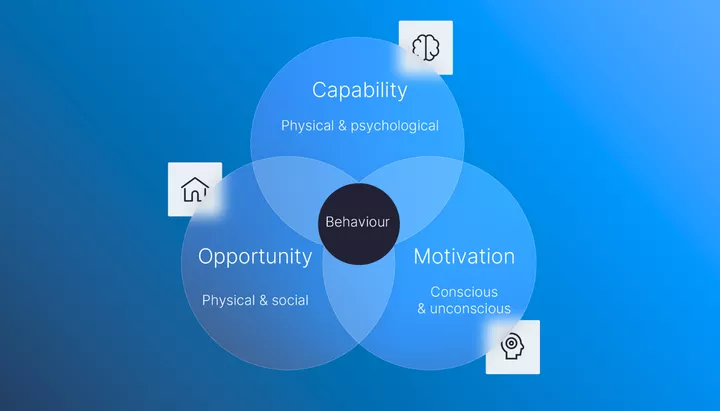
The COM-B model shows that behaviour results from the interaction between Capability, Opportunity and Motivation. Below, we explore what these three factors mean in the context of secure behaviour.

Capability is divided into psychological and physical capability. Psychological capability means having the knowledge needed to behave securely in a digital environment. For example, does someone know how to enable MFA? Can they recognise the signs of a phishing email? Do they know what makes a strong password?
Physical capability refers to the physical skills needed to perform a behaviour. For example, can someone lock their laptop, share files securely or report a phishing email correctly?
Opportunity covers both the social and physical environment. Does the environment enable employees to behave securely? The physical environment determines whether employees have access to the tools and resources they need. For example, is there a central reporting channel for phishing? Are policies easy to find and follow? Is the organisation’s password policy supported by providing employees with a password manager?
The social environment also influences whether secure behaviour feels like the natural thing to do. In other words: does the environment encourage people to behave securely? If you rarely see locked screens around the office, you may be less inclined to lock your own screen when you leave your desk.
It is also important to look at the behaviour of managers and senior leadership. Do leaders set the right example by showing how they handle information securely? Is there a social norm that encourages people to work securely?
People tend to model and imitate the behaviour they see around them. In the workplace, they look to colleagues and managers for cues on how to behave. So, lead by example. As a leader, take the initiative and demonstrate what secure working looks like in practice.
Motivation refers to the conscious and unconscious drivers that guide, encourage or inhibit our behaviour. Conscious motivation, also known as reflective motivation, includes deliberate decisions, beliefs, goals, intentions and plans. Someone who is consciously motivated considers information security important. They understand why it matters and make a deliberate effort to work securely. For example, they may consciously choose to carry out an additional check before sharing information.
Unconscious motivation relates to our impulses, habits and emotions. Secure behaviour can happen almost automatically once it becomes a habit. But the opposite is also true. Once locking their screen has become a habit, an employee will do it almost automatically when leaving their desk. Without secure habits in place, however, an employee may automatically click a link without checking it first.
Conscious motivation helps turn secure behaviour into an unconscious habit. When employees are motivated to behave securely, they are more likely to develop habits that make secure behaviour increasingly automatic.
Tips for building motivation:
The COM-B model helps you look beyond good intentions alone. By examining whether employees are capable of performing the desired behaviour, whether their environment supports it and whether they are sufficiently motivated, you gain a clearer understanding of what may be preventing secure behaviour.
So do not just ask: “Do employees know what they need to do?”
Also ask: “Is the behaviour easy to carry out, and is it sufficiently encouraged?”
This helps you avoid wasting time on isolated interventions that have little impact. Instead, you gain practical insights that can help you build lasting secure behaviour: behaviour that employees not only understand, but also put into practice and maintain over time.


Training modules
Customers worldwide
Employees trained

Step aboard and build lasting security awareness with Awaretrain.